Loading

Astrosophy
Astrosophy holds the moving sky, a birth chart, and the human constitution in one application. Begin with Today, follow planetary movement in Macroscope, read in the Library, and use Self to set those studies beside your own biography.
Calculated positions, source material, and questions for reflection appear with their own context. Follow the geometry, open a reading, and return to the source as your understanding develops.
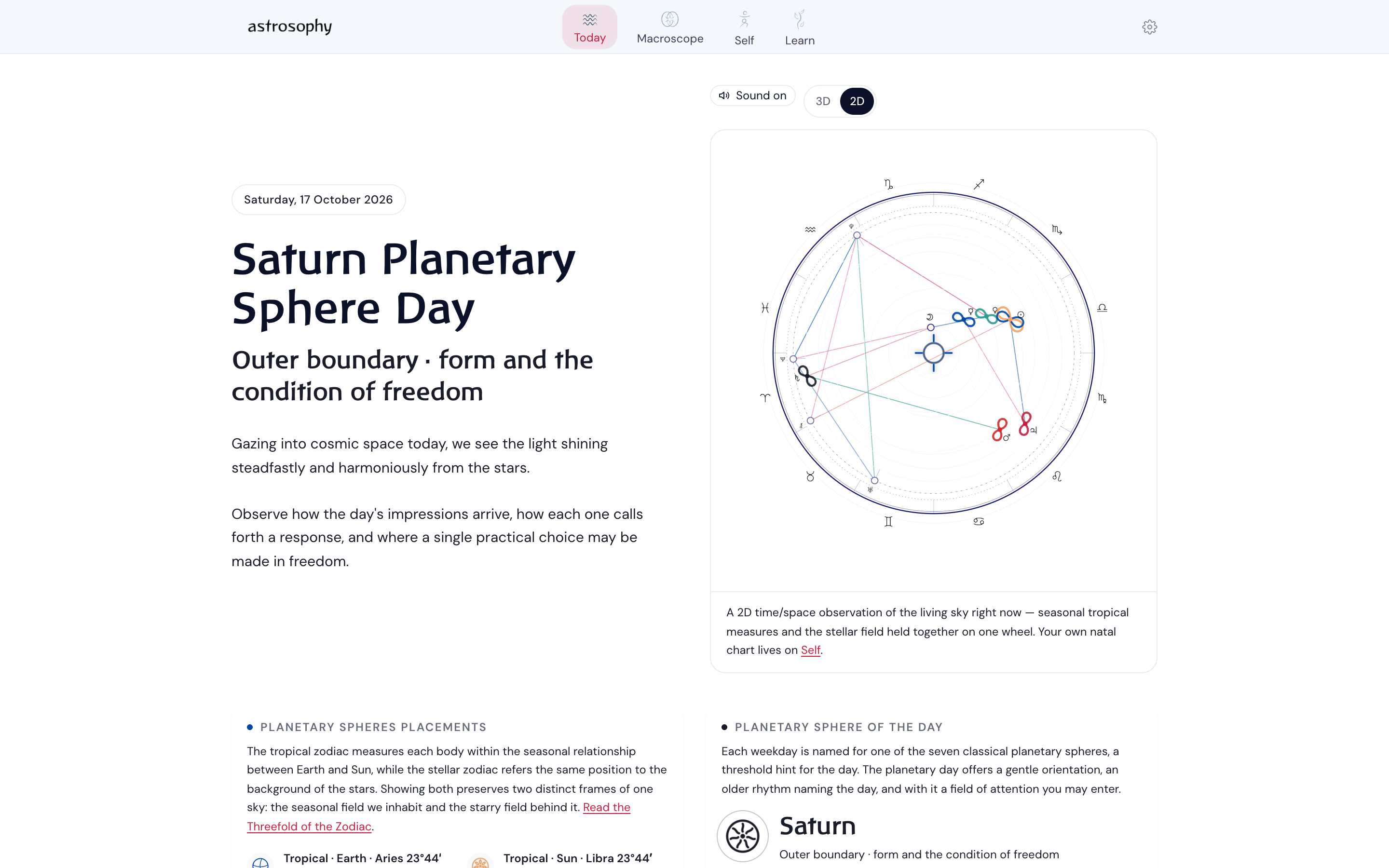
Today opens with the planetary sphere that names the weekday and one prompt for observation. The current sky appears as a wheel; the optional 3D view opens the moving picture. The placement list gives each body its tropical position and its position against the stars.
Daily sky highlights and the eclipse-season card mark movements worth watching. The readings below them introduce spiritual science, the planetary spheres, the fixed stars, individuality, and lemniscatory astronomy. Return daily and compare the changing sky with the attention you bring to it.
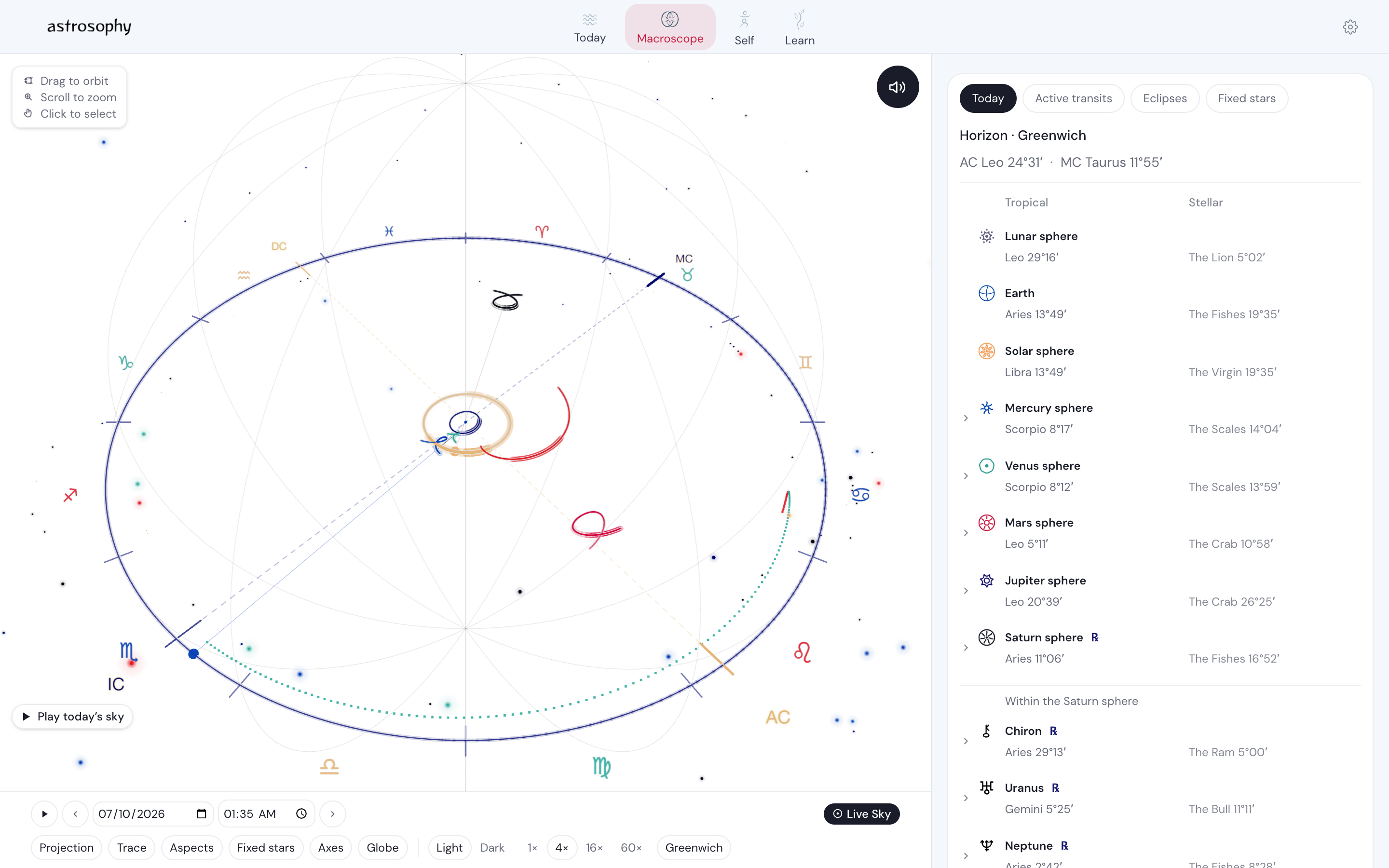
Macroscope is an Earth-centered planetarium. You can set a date and time, return to the live sky, or play the movement forward and backward. The transport controls the playback speed, the standpoint, the sky ground, and which structures are drawn.
The gesture, lemniscate, and Cassini views are three ways of drawing the same calculated positions. Zodiac layers, nodes, aspect lines, and sphere readouts let you follow one configuration as it changes. Each aspect carries a musical interval on hover, and the tone can be muted.
Macroscope draws every body from the ephemeris, which gives the same calculated positions that place a planet in a sign and degree. The view is geocentric, so the planets trace the apparent path seen from Earth. When a sphere appears to slow, stop, and move backward, Macroscope draws the loop itself, which is the astronomy behind the word "retrograde," and it leaves the body’s own motion unchanged.
Mercury and Venus run cycles that can be followed through conjunction, station, apparent retrograde motion, and morning or evening visibility. The cycle panels gather those phases with their dates and Earth distances.
The 2026 study presents the dated Venus and Mercury cycles.
The figure-eight enters this app through Steiner’s astronomical proposals and later reconstructions, including the work of Roland Schrapp. As a teaching form it makes rhythmic movement, approach, withdrawal, and metamorphosis visible in one gesture.
The ephemeris supplies calculated positions. The lemniscate supplies a form for study. Both are shown, and the explanation accompanying each view states which is which.
In the Astrosophy tradition, the visible planets are the signatures of living spiritual activities, and each of them is a region of soul experience and formative work with its own quality. Astrosophy describes the seven classical spheres as the moving voices through which the fixed, formative order of the zodiac speaks.
Each sphere’s drawn sign follows its formative gesture, so Saturn, for example, appears as striving rays.
 Saturnstriving rays
 Jupiterchalices
 Marspillars and apex
 Sunliving tips
 Venusone bloom
 Mercuryentwined
 Moonfruit carriers
Enter your birth date, place, and as much time information as you have. Macrocosm offers 2D, 3D, and lemniscate views with a reading rail in four parts: Spheres, Incarnation, Elemental, and Biography.
Spheres opens with the qualities of the birth moment — day or night, the Moon’s phase, the Sun’s half of the year — then the seven planetary spheres, the bodies within Saturn, and Earth, the nodes, and the angles. Open any row for its reading, its relationships, and the fixed stars gathered there. Horizon-dependent material follows the birth time you can give.
Elemental groups the natal placements by element and modality. Worldviews, moods, and tones offer further ways to contemplate the configuration.
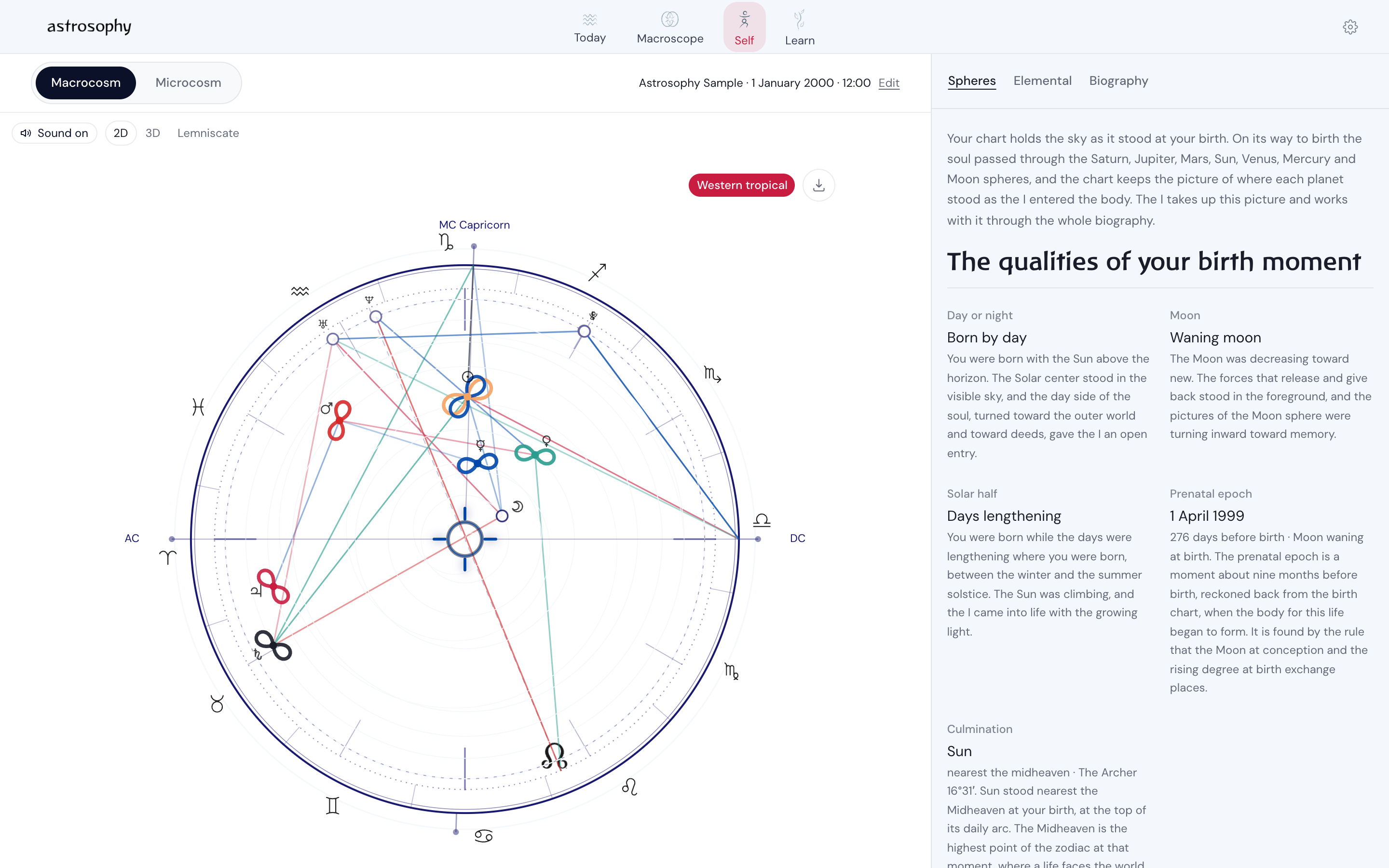
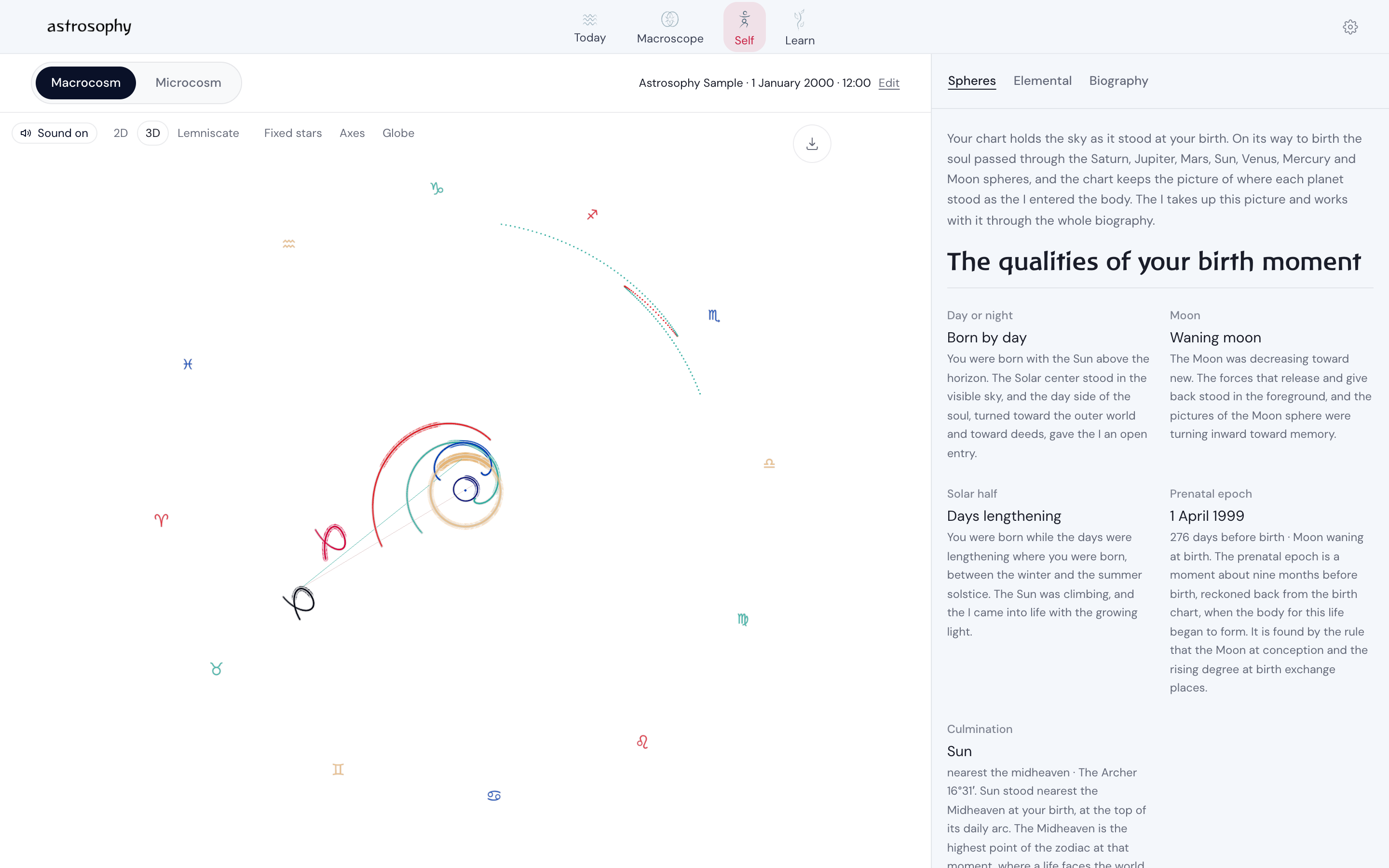
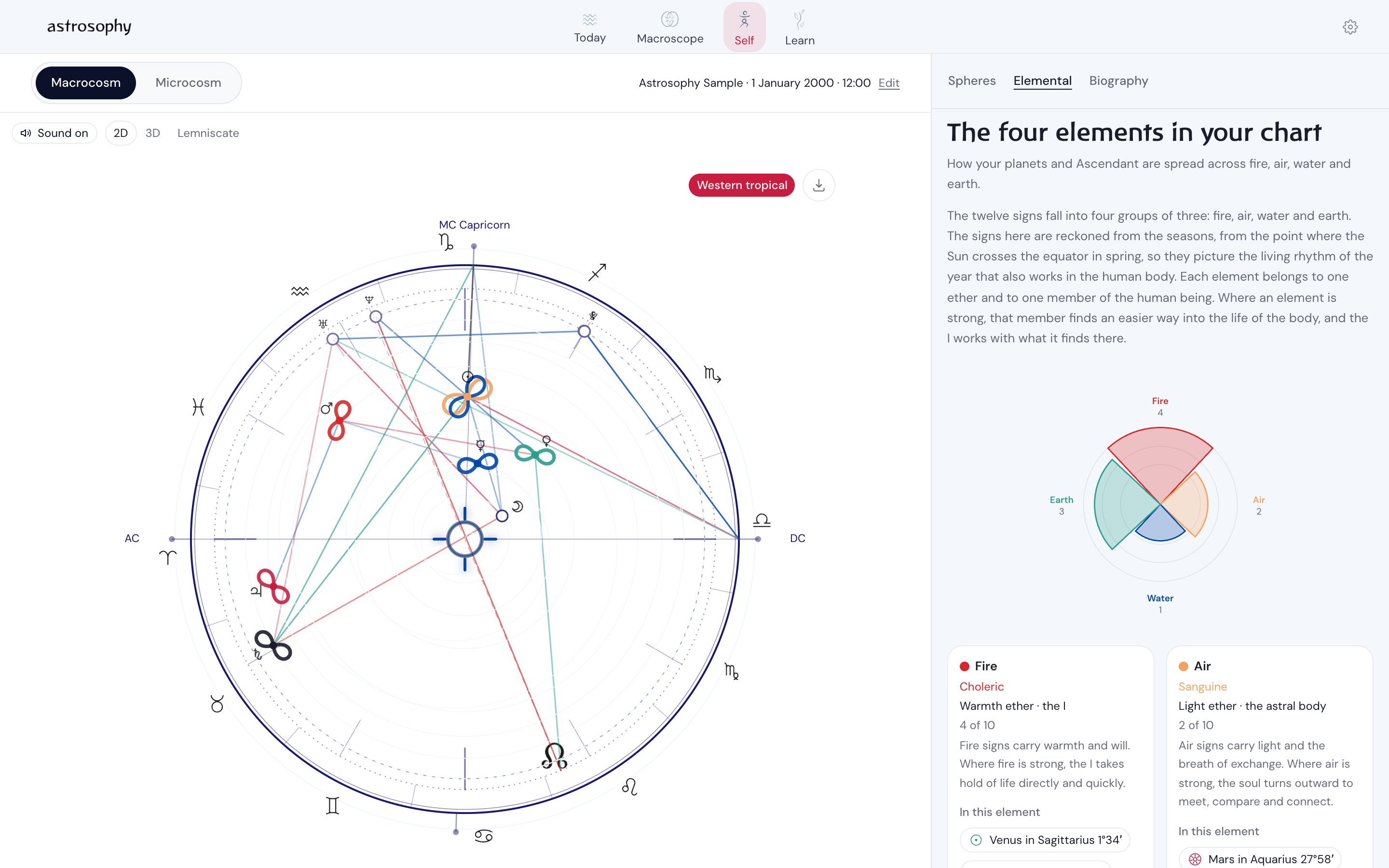
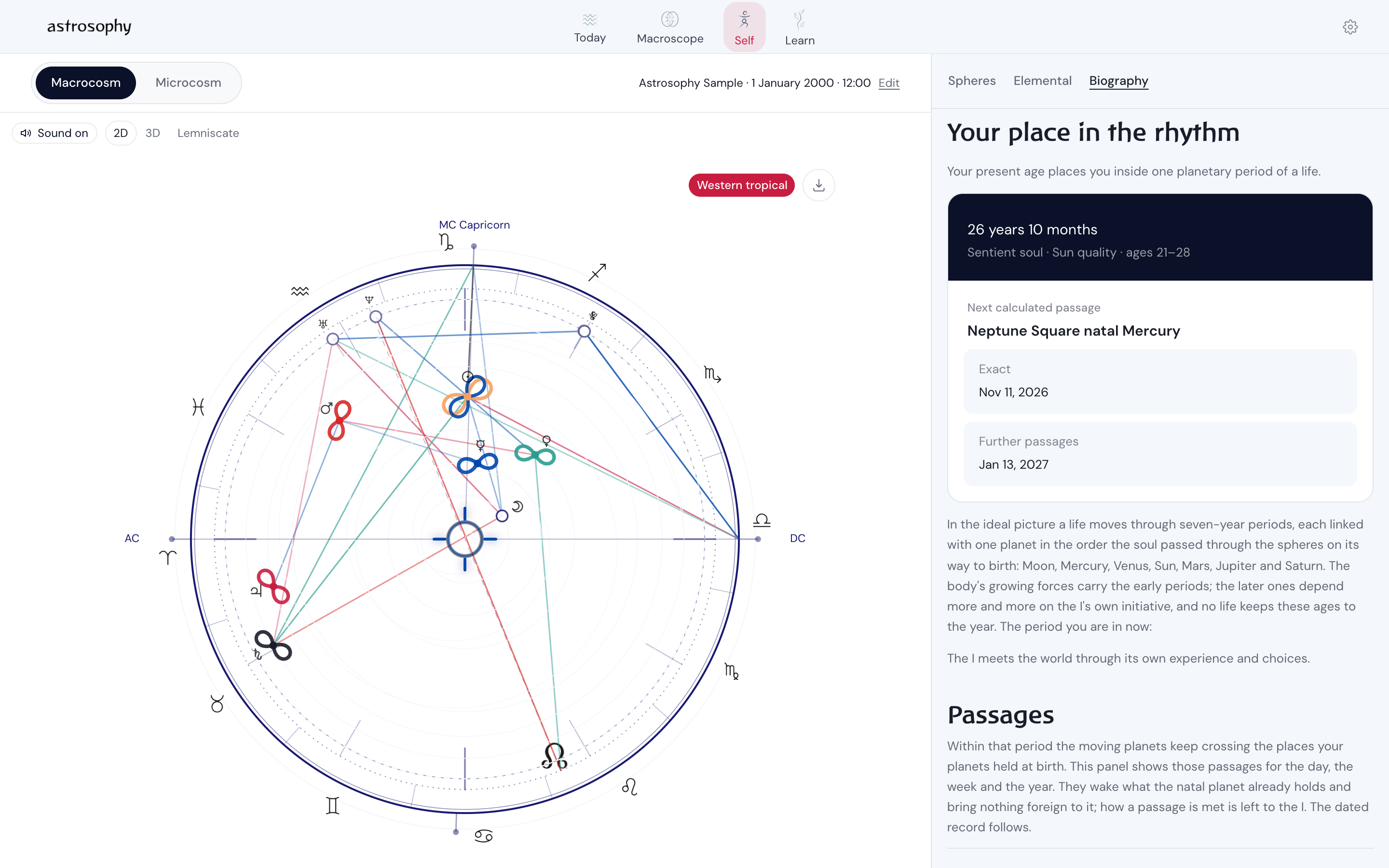
The Incarnation area of Macrocosm follows the soul’s ascent, the cosmic midnight, and the descent toward earthly life, with sphere readings and natal references at each region.
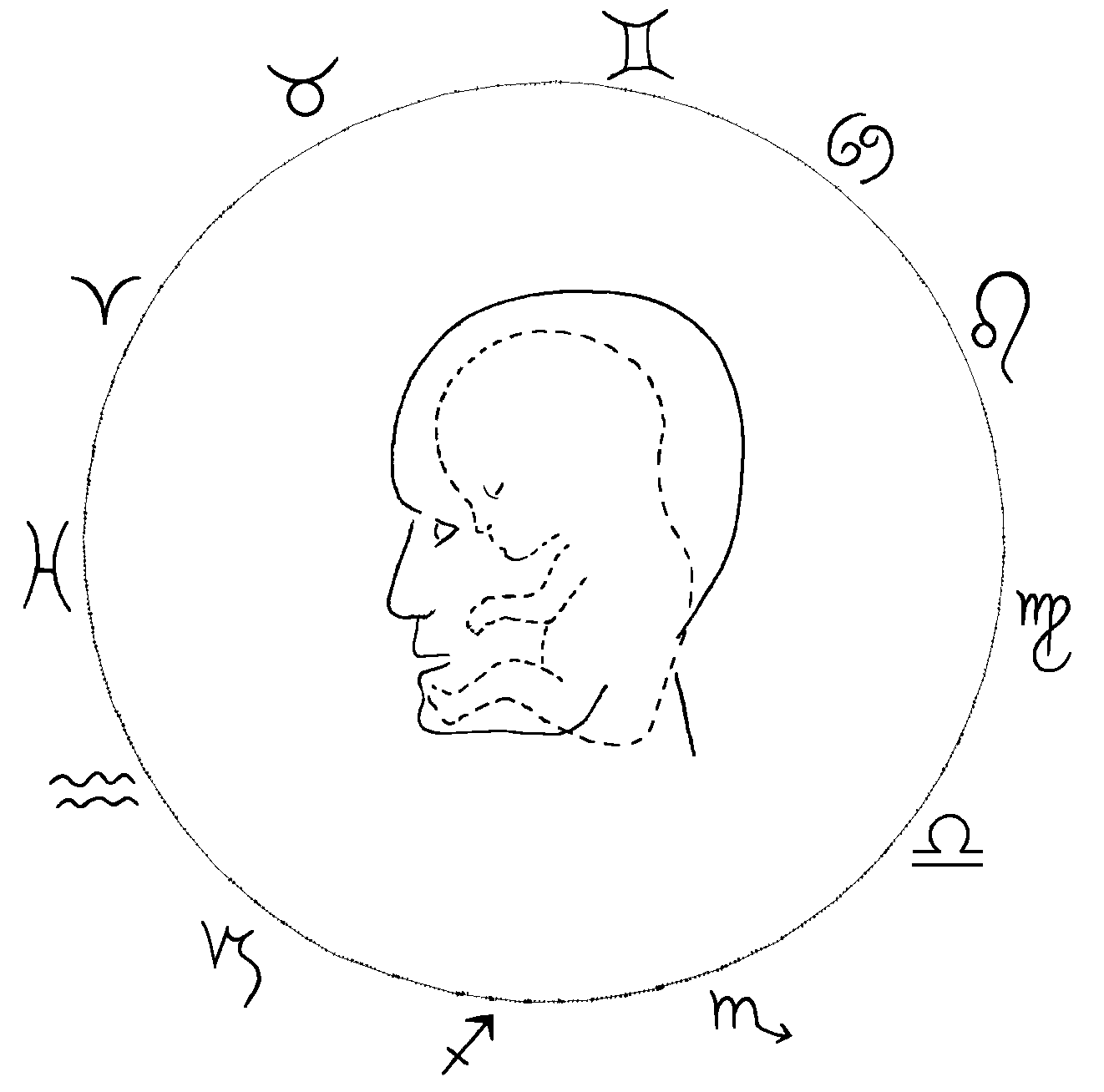
The threefold incarnation study places head, trunk, and limbs within its account of previous, present, and future life. Each diagram keeps the context of its teaching so the pictures can be compared without merging their correspondences.
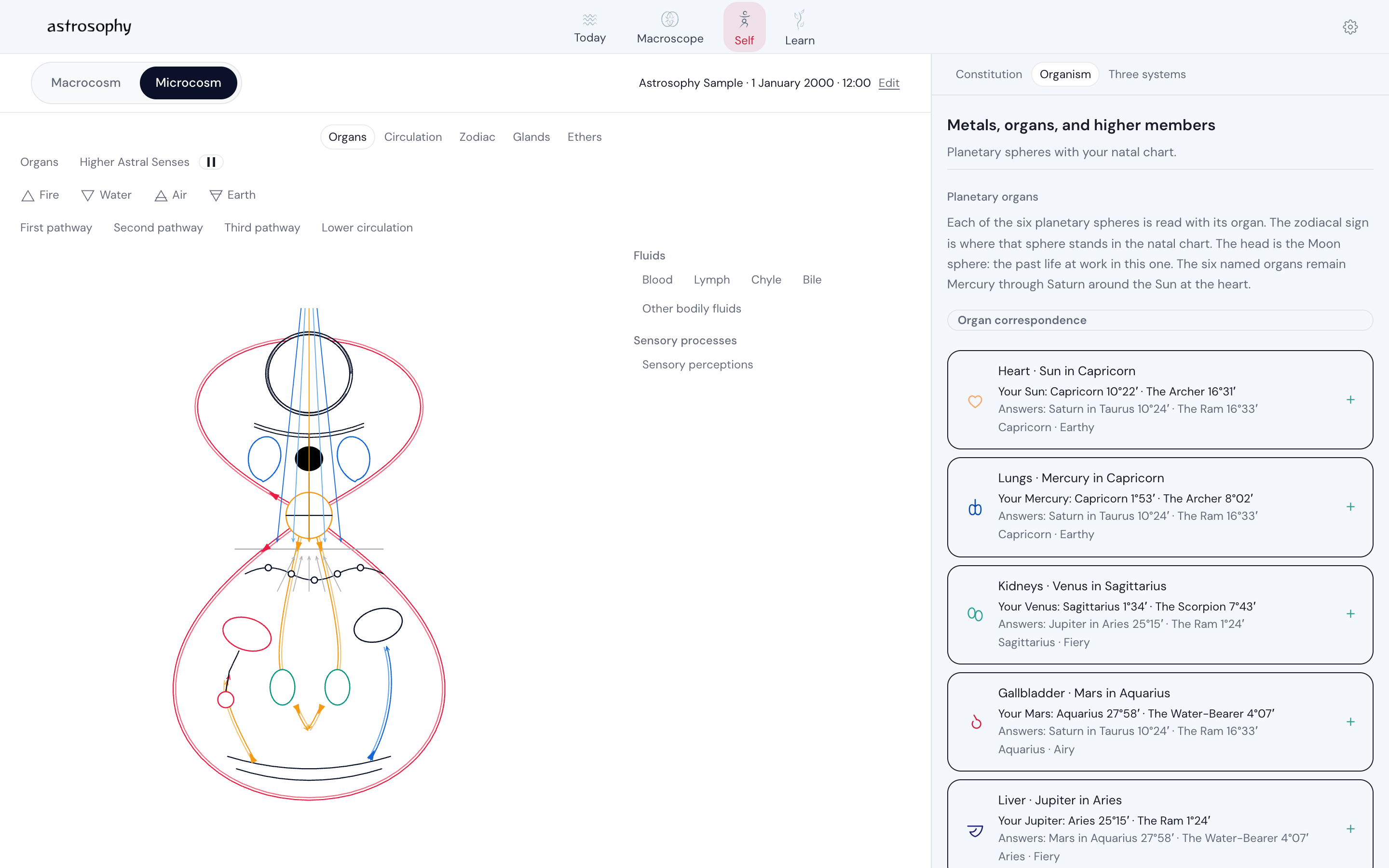
Microcosm keeps a human figure beside three reading areas: Organism, Constitution, and Soul. Select an organ or a region to open its reading and follow the connections drawn on the figure.
Organism covers the planetary and metal correspondences, the life processes, the elements, the fluids, and the body rhythms. Some readings show your natal placement; the figure and its pathways present the shared teaching.
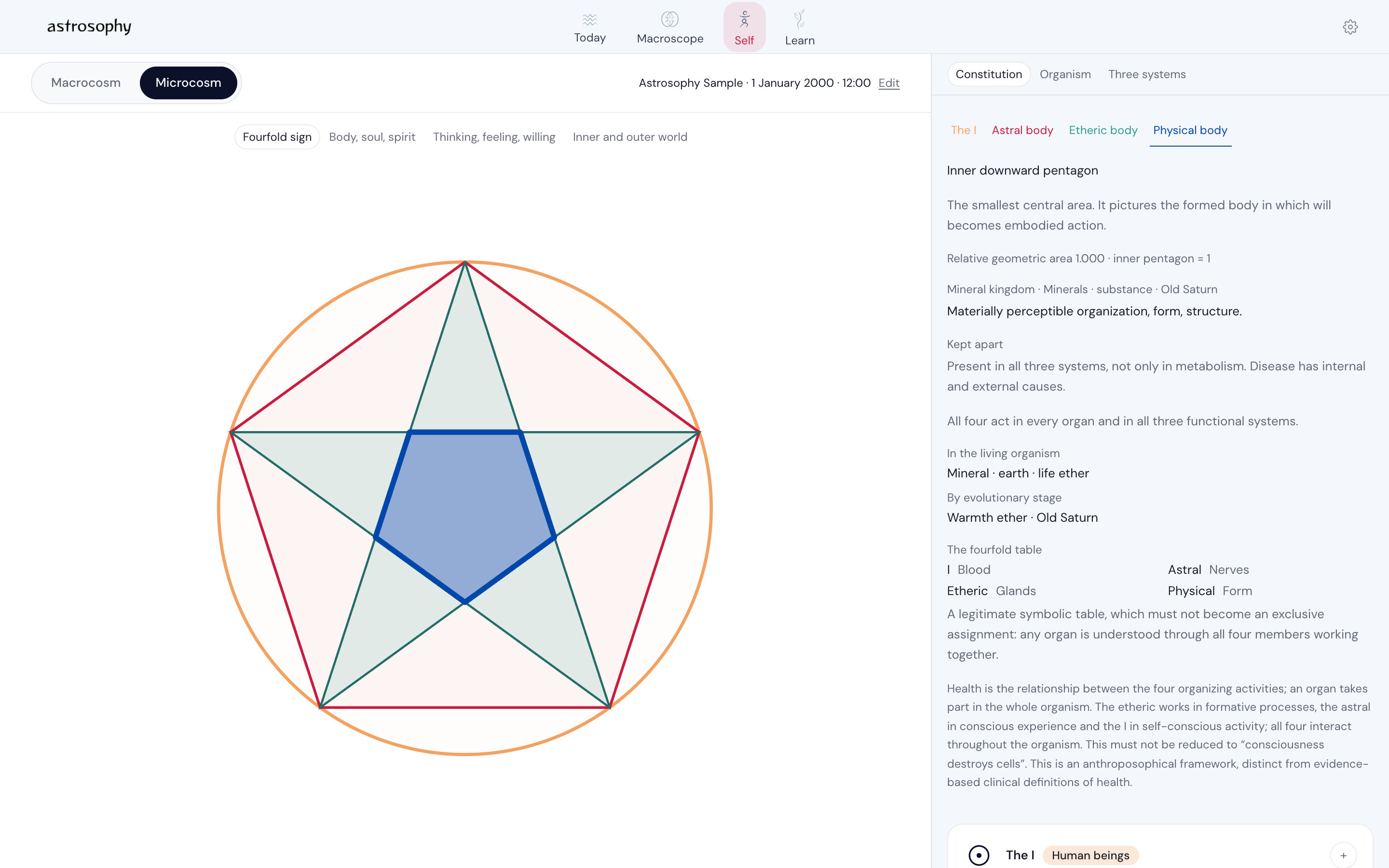
Constitution holds the physical, etheric, astral, and I-organization, together with the ninefold account, the threefold systems, and the fourfold time study. Soul holds the Golden Triangle, Cosmosophy, the zodiac and body principles, and the higher astral senses.
Biography sets calculated passages beside the seven-year phases of life. Browse a month’s transits, filter the longer sequence by transits or progressions, and open a row for its date, its exact phases, its natal foundation, and its reading.
The seven-year view shows your age and current phase within the sequence of body, soul, and spirit development. Planetary returns and secondary progressions give further points from which to remember a period and see what has changed.
A passage takes its meaning from the experience you bring to it. Revisit a reading later and consider how your own choices entered the situation.
The Library is public and collects essays, studies, and references. You can search the catalog, choose a type, or filter by one of its areas: Spiritual Science, Astrosophy, Cosmology, the Human Being, Karma and Incarnation, Spiritual Beings and Hierarchies, or Sources and Studies.
Featured readings cover lemniscatory astronomy, the fixed stars, the threefold zodiac, the music of the planetary spheres, and the foundations of Astrosophy. The glossary defines the terms the app uses; the constitution and Cosmosophy studies offer longer paths.
Today, Macroscope, and the Library are open to every visitor. Creating an account starts a 30-day trial that needs no card. After that, lifetime access is a single payment of $30, including new releases and features across Macrocosm and Microcosm as the project develops; the trial and lifetime access both open the same personal app.
Settings holds your birth details and account controls. Return to your chart as your biography develops, and keep the public sky and Library alongside the personal readings.