
How it started
Anthroposophy approaches the relationship between the human being and the cosmos as a spiritual and philosophical tradition, distinct from both modern astronomy and popular astrology. Rudolf Steiner placed cosmic questions inside a much larger investigation of consciousness, freedom, human development, nature, spiritual experience and the history of the universe. Elisabeth Vreede carried part of that work into the Mathematical Astronomical Section at the Goetheanum, where mathematics, observational astronomy and Anthroposophical cosmology were studied together. Willi Sucher later developed Astrosophy as a modern form of star wisdom grounded in Steiner’s work and shaped by his contact with Vreede. The official Astrosophy archive dates that development from the 1920s until Sucher’s death in 1985. Astrosophy is a twentieth century development with its own sources, methods and spiritual assumptions, not a new label for conventional astrology.
Astrosophy touches several kinds of claim at once. Anthroposophy and Astrosophy belong to spiritual inquiry; modern astronomy describes celestial phenomena through observation, measurement and mathematical models. A mathematical lemniscate is a defined curve. A solar analemma is an observed annual pattern caused by the geometry of Earth and Sun. Retrograde loops are apparent paths produced by relative planetary motion and the observer’s position. Chronobiology studies rhythms in living organisms, and psychology studies the human experience of time. These subjects can illuminate one another, but a shared vocabulary or a visual resemblance does not prove that they describe the same process.
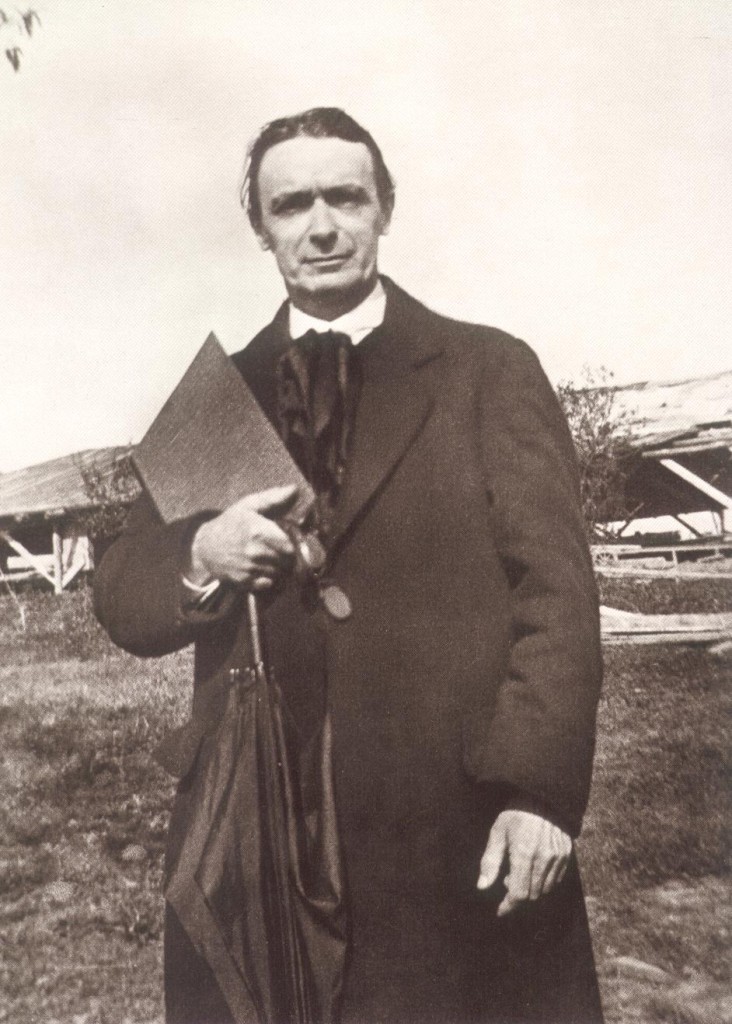
Image: Rudolf Steiner in 1914, unknown photographer, public domain via Wikimedia Commons.

The reading begins with Steiner’s foundational books, before planetary symbolism or chart construction. Theosophy introduces the bodily, soul and spiritual dimensions of the human being, along with karma, reincarnation and supersensible worlds. How to Know Higher Worlds explains the method of inner development Steiner associated with spiritual knowledge. An Outline of Esoteric Science connects the constitution of the human being with sleep, death, initiation, cosmic evolution and the stages Steiner called Old Saturn, Old Sun, Old Moon and Earth. Human and Cosmic Thought then introduces the relationship among philosophical standpoints, planetary modes and zodiacal images. Man: Hieroglyph of the Universe develops the relationship between microcosm and macrocosm, while GA 323 brings the reader into astronomy, geometry, planetary loops, Cassini curves and lemniscatory movement. Vreede, Sucher and Jonathan Hilton follow this foundation, so that terms such as etheric, astral, planetary sphere, incarnation and spiritual hierarchy arrive with the conceptual world that gives them meaning.
The primary Rudolf Steiner archives and foundational books
The main English language source is the Rudolf Steiner Archive, which provides books, lectures, essays, GA number browsing, date searches, translation comparisons and access information. Its book index is the quickest entrance to Steiner’s written works, while the Rudolf Steiner e.Lib and its book collection provide alternative editions and downloadable formats. Audio study is available through Rudolf Steiner Audio, where Dale Brunsvold’s recordings can be searched by title or through the GA order catalogue. Titles vary between translations and recordings, so the GA number is more reliable than the English title when matching a text to its audio edition. Reading and listening can support each other, but the printed page remains necessary wherever the lecture depends on diagrams, unusual terminology or a precise sequence of argument.
Steiner’s philosophical foundation is The Philosophy of Freedom, also published as Intuitive Thinking as a Spiritual Path and catalogued as GA 4. The 1916 English translation was sanctioned during Steiner’s lifetime, while the archive also holds later versions. Its importance for Astrosophy is indirect but central because it asks what thinking is, how knowledge arises and whether human action can become free. Without that foundation, a study of planetary spheres and zodiacal symbols can become a passive accumulation of correspondences. The next foundation is Theosophy, GA 9, which establishes the vocabulary of body, soul, spirit, reincarnation, karma and the spiritual worlds. The archive landing page includes several translations and a comparison tool, which is valuable because terms can differ substantially between editions.
How to Gain Knowledge of the Higher Worlds, GA 10, is also published as How to Know Higher Worlds and Knowledge of the Higher Worlds and Its Attainment. It presents the disciplines and stages of inner development that Steiner believed were required for direct spiritual knowledge. His cosmological statements were not offered merely as alternative physical hypotheses. Occult Science: An Outline, GA 13, now often titled An Outline of Esoteric Science, supplies the broad cosmological framework through its treatment of sleep, death, spiritual worlds, cosmic evolution, initiation and future human development. The corresponding GA 13 recording can be found in the audio catalogue under the older title. A reader who understands these works will be better prepared for the planetary names and evolutionary stages used throughout the later cosmological lectures.
Steiner’s own position on astrology should be read directly rather than summarized as simple acceptance or rejection. His essay “What Is the Relationship Between Theosophy and Astrology?”, included in GA 34, criticizes formulaic astrological rules while locating what he regarded as genuine astrology within supersensible cognition and wider cosmological knowledge. Read directly, the essay sets the terms of Steiner’s argument rather than settling the question of astrology, and it keeps later practices from being attributed to him without evidence.
After the foundational books, the study can move into the lecture cycles where the human being is increasingly described in relation to spiritual hierarchies and celestial bodies. Spiritual Hierarchies and Their Reflection in the Physical World, GA 110, consists of lectures delivered in April 1909 and provides a background for Steiner’s account of spiritual beings acting through the physical cosmos. Spiritual Beings in the Heavenly Bodies and in the Kingdoms of Nature, GA 136, develops this account in relation to stars, planetary spheres, natural kingdoms and spiritual hierarchies. The GA 136 comparison index is useful because it gathers different translations and additional lecture material. These cycles explain why the names of planetary spheres and zodiacal regions carry meanings in Anthroposophy that extend beyond the physical objects and coordinate systems used in astronomy.
Human and Cosmic Thought, GA 151, is the clearest bridge from philosophical thinking into cosmological symbolism. The four lectures were delivered from January 20 through January 23, 1914, and relate twelve philosophical standpoints to zodiacal images and seven modes or moods of thought to planetary principles. It is not a conventional astrology manual: it shows how a worldview becomes one sided when it treats one standpoint as the whole truth, and it uses cosmic imagery to move among different modes of thought. Its recording can be found by searching for GA 151 in the Rudolf Steiner Audio catalogue.
Man: Hieroglyph of the Universe, GA 201, contains sixteen lectures delivered from April 9 through May 16, 1920. It develops the idea that the human organism cannot be understood in isolation from cosmic rhythm, zodiacal relationships, precession, Earth and the heavens. The work should sit beside Astrosophical charts because it gives the microcosm and macrocosm relationship a fuller conceptual setting. Audio editions may appear under the title Mystery of the Universe, so GA 201 should be used when searching the audio catalogue. Read before Sucher, these cycles show which concepts he inherited, which he developed and where a later interpretation begins.
GA 323, lemniscatory movement and spatial thinking
The central astronomy course is GA 323, an eighteen lecture cycle delivered from January 1 through January 18, 1921. It is variously titled Third Scientific Lecture Course: Astronomy, The So Called Astronomy Course and Interdisciplinary Astronomy. The complete archive page includes the editor’s note, Elisabeth Vreede’s foreword, the lecture sequence and the surviving figures. Steiner moves among astronomical observation, geometry, mathematics, human morphology, spatial perception, planetary loops, Copernican astronomy, Kepler, Cassini curves, the relationship between Earth and Sun and the form of the human organism. The course should therefore be read as a developing investigation rather than reduced to one quotation or one diagram. Its audio version can be located through Rudolf Steiner Audio by searching for GA 323 or the alternate titles.
Lecture XII, delivered on January 12, 1921, is important because Steiner discusses three formative principles: the sphere, the radius and the moving or looped lemniscate. He relates these principles to human morphology and describes the lemniscate as variable rather than as one fixed decorative shape — a point that shapes how any later diagram of it is read.
Lecture XVII, delivered on January 17, 1921, is the primary source for the best known planetary lemniscate discussion. Steiner asks the listener to imagine the flat drawing as a projection of a spatial process and to consider the rotation of its plane. His sketch connects Earth, Sun, Mercury, Venus, the inner planets, the outer planets and several lemniscatory curves. The image is study material rather than a finished model of celestial mechanics. It is best read beside the observed planetary motion it is meant to illuminate.
The mathematical background prevents the symbol from becoming vague. The Bernoulli lemniscate is a defined curve within the family of Cassini ovals. A Cassini oval is defined through the product of distances from two fixed focal points, and different parameter relationships produce a single oval, a figure eight or two separate loops. The Wikimedia Commons Cassini oval image search and the Lemniscate of Bernoulli collection provide diagrams and animations. The Fourth Dimension, GA 324a, supplies further background on projection, dimensionality and spatial transformation. Its audio edition can be found through the GA order catalogue. This work becomes especially useful when GA 323 asks the reader to understand a planar drawing as the projection of a spatial relationship.
Steiner’s surviving blackboard drawings show how visual thinking accompanied the spoken lectures. The Anthroposophie Switzerland introduction explains how black paper was placed over lecture boards so that the chalk drawings could be preserved, and reports that approximately 1,100 examples survive. Each is dated to the lecture it accompanied, so it can be read beside what the audience was hearing at the time.
Elisabeth Vreede and the Mathematical Astronomical Section
Elisabeth Vreede is essential to the history that connects Steiner’s cosmology with Sucher’s Astrosophy. She was a Dutch mathematician and astronomically trained Anthroposophist whom Steiner appointed to lead the Mathematical Astronomical Section of the School of Spiritual Science at the Goetheanum. The official history of the Section states that it was founded during the 1923 Christmas Conference because Steiner regarded Vreede as qualified to represent mathematics and astronomy. A recent Goetheanum essay on Vreede provides further biographical and institutional context, including the responsibilities attached to her role.
Vreede’s astronomical letters were published in English under titles including Astronomy and Anthroposophy, Anthroposophy and Astrology and Astronomy and Spiritual Science. They discuss daily stellar movement, annual solar movement, the planetary system, Mercury and Venus, eclipses, precession, nutation and the relation between astronomical observation and spiritual science. The Elisabeth Vreede publication page provides information, samples and supporting documents, though it does not offer a complete free English edition.
The Mathematical Astronomical Section website remains an important institutional resource for astronomy, projective geometry, rhythm research, qualitative mathematics and the relation between humanity and the cosmos. The Section also maintains the Johannes Kepler Observatory. Its observatory history is in German and records that the observatory’s first telescope was acquired by Vreede and is partly preserved as a historical object. Anthroposophical cosmology did not develop only through abstract symbols; it also grew beside observing, maintaining instruments and teaching astronomy.
Willi Sucher, the Astrosophy archive and modern study
The official Astrosophy website describes Astrosophy as the star wisdom developed by Willi Sucher from the 1920s until 1985 on the foundation of Steiner’s spiritual science. Sucher studied human biography in relation to cosmic configurations through birth, prenatal development, death, planetary spheres and historical rhythms. His work is a particular development rather than Steiner’s own system; the historical question is not only what he drew from Steiner, but how he turned those indications into chart construction and biographical research.
The official Sucher publications library offers free authorized downloads of the major books, with page counts and edition details for printed copies. The collection includes Astronomische Rundschreiben, written with Elisabeth Vreede, Cosmic Christianity and the Changing Countenance of Cosmology, the three Isis Sophia volumes, the three Practical Approach collections, The Drama of the Universe, Living Universe, the Cosmology Course and the collected articles. Isis Sophia I introduces Astrosophy through a sequence of astronomical letters. Isis Sophia II develops a new star wisdom through planetary spheres, zodiacal relationships and cosmic evolution. Isis Sophia III turns more directly toward the human relationship with the stars. The practical volumes show the method working through journals and correspondence rather than presenting it only as a finished doctrine.
The official Sucher article archive contains early writings from 1937 and 1938 that appeared under the name John Seeker. These articles address prenatal astrology, birth charts, the Moon, historical personalities and stellar events, and they allow the reader to see the method developing over time. The letters and lectures collection is more advanced: its introduction says the astronomical letters assume familiarity with Steiner’s basic books and Sucher’s publications.
Jonathan Hilton’s Speaking to the Stars: An Introduction to Astrosophy, published in 2023, provides the clearest modern entry into the field. It begins with the zodiac and the planets, explains chart construction and then develops the spiritual background of practical Astrosophy. The official Astrosophy site provides its current publication and free-download page. Hilton’s book works best after the Steiner foundations, where it can serve as a bridge into Sucher rather than a substitute for the historical sources.
Later Astrosophy and experimental cosmic research
Robert A. Powell continued themes found in Sucher while developing a distinct body of work concerned with the sidereal zodiac, fixed stars, Christian Hermetic astrology, the chronology of the life of Christ, Sophia, sacred movement and proposed reincarnation relationships. His Sophia Foundation biography records his mathematical training, doctoral research on the history of the zodiac and later teaching, while the Robert Powell book catalogue provides a useful survey of works including Chronicle of the Living Christ, Christian Hermetic Astrology, The Sophia Teachings and The Astrological Revolution. Powell’s coordinate choices, chronologies and reincarnation proposals belong to his later research stream, and are explicit reconstructions rather than positions of Steiner, Vreede or Sucher.
George Adams approached the question of living space through projective geometry rather than through a horoscope system. His work, later developed with Olive Whicher, explored polarity, infinity and the contrast between physical, point-centred space and the peripheral or etheric space proposed for living form. Open Library’s George Adams catalogue gathers his publications, while the bibliographic record for Adams and Whicher’s The Plant Between Sun and Earth and the Science of Physical and Ethereal Spaces identifies the work most directly relevant to the relation among geometry, plant morphology and formative processes. Adams extends the spatial questions of the astronomy course, though his projective geometry is a different project from both standard astronomical mechanics and Sucher’s Astrosophy.
Lemniscatory time, later reconstructions and comparative research
The Anthroposophy.eu page “Lemniscatory Time and Space” is a secondary Anthroposophical compilation that gathers material from GA 171, GA 183, GA 184, GA 201, GA 323, GA 324a and other sources. It works as a research map; each GA citation it gathers can be followed back to the original lecture. It also gathers material on projection, counterspace, evolutionary reversal and different conceptions of time, and its claims remain interpretation until checked against the primary text.
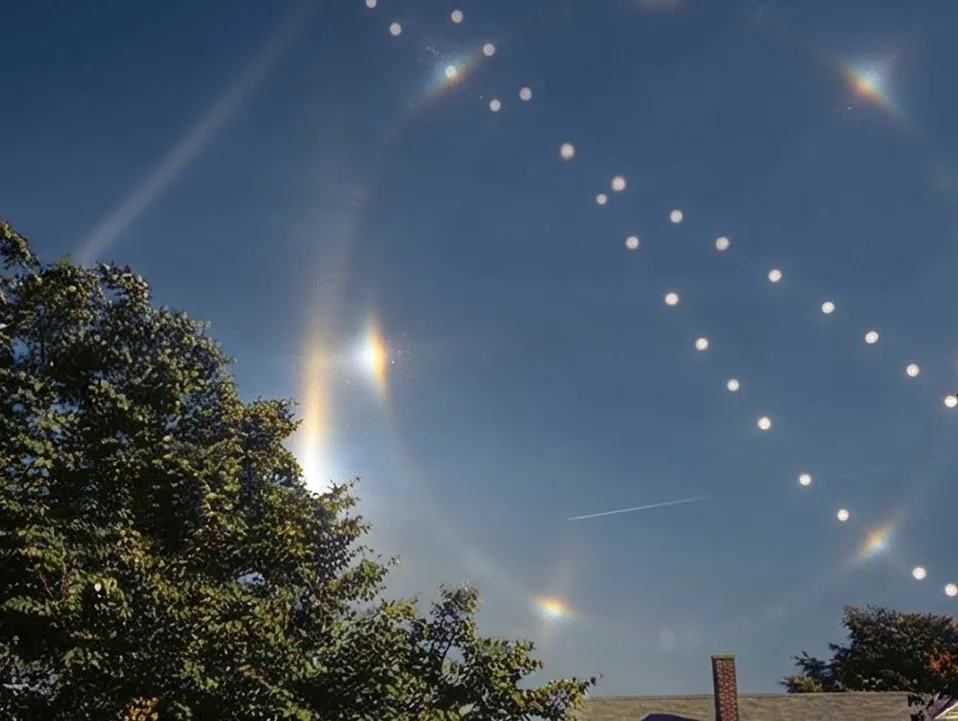
The phrase “lemniscatory time” can name several distinct questions. In mathematics, the lemniscate is a defined curve. In astronomy, retrograde loops are apparent paths created by relative motion, while the solar analemma is the annual figure eight pattern formed when the Sun is recorded from the same place at the same clock time. The analemma results from Earth’s axial tilt, orbital motion and the observer’s terrestrial viewpoint. Steiner’s GA 323 lemniscates belong to a spiritual cosmological proposal concerning the relationship among the human being, Earth, Sun and planets. Biological time concerns living rhythms such as sleep, waking and seasonal organization, while psychological time concerns memory, anticipation, attention and the way equal clock durations can feel different.
Roland Schrapp’s Lemniscatory Path System, Parts 1 through 3, is a substantial later attempt to reconstruct Steiner’s planetary indications and compare them with astronomical phenomena. It contains many figures and openly addresses the difficulty of reconciling the proposed paths with the standard Copernican and Keplerian account. That makes it valuable as an interpretive reconstruction, though not as original Steiner material or established astronomical mechanics. Read beside a standard heliocentric model, the observed geocentric loops and Steiner’s GA 323 drawings, it shows how much depends on which assumptions and which purpose of description are chosen.
A study sequence
The order that holds together runs from foundations into cosmology, then into mathematics and astronomy, and only afterward into Astrosophy and comparative time research. The first stage establishes Steiner’s account of thinking, the human constitution and spiritual knowledge through The Philosophy of Freedom, GA 4, Theosophy, GA 9, How to Gain Knowledge of the Higher Worlds, GA 10, and Occult Science: An Outline, GA 13.
The next stage works through Spiritual Hierarchies and Their Reflection in the Physical World, GA 110, Spiritual Beings in the Heavenly Bodies and in the Kingdoms of Nature, GA 136, Human and Cosmic Thought, GA 151, and Man: Hieroglyph of the Universe, GA 201, while the learner acquires basic knowledge of the zodiac, precession, planetary positions and coordinate systems.
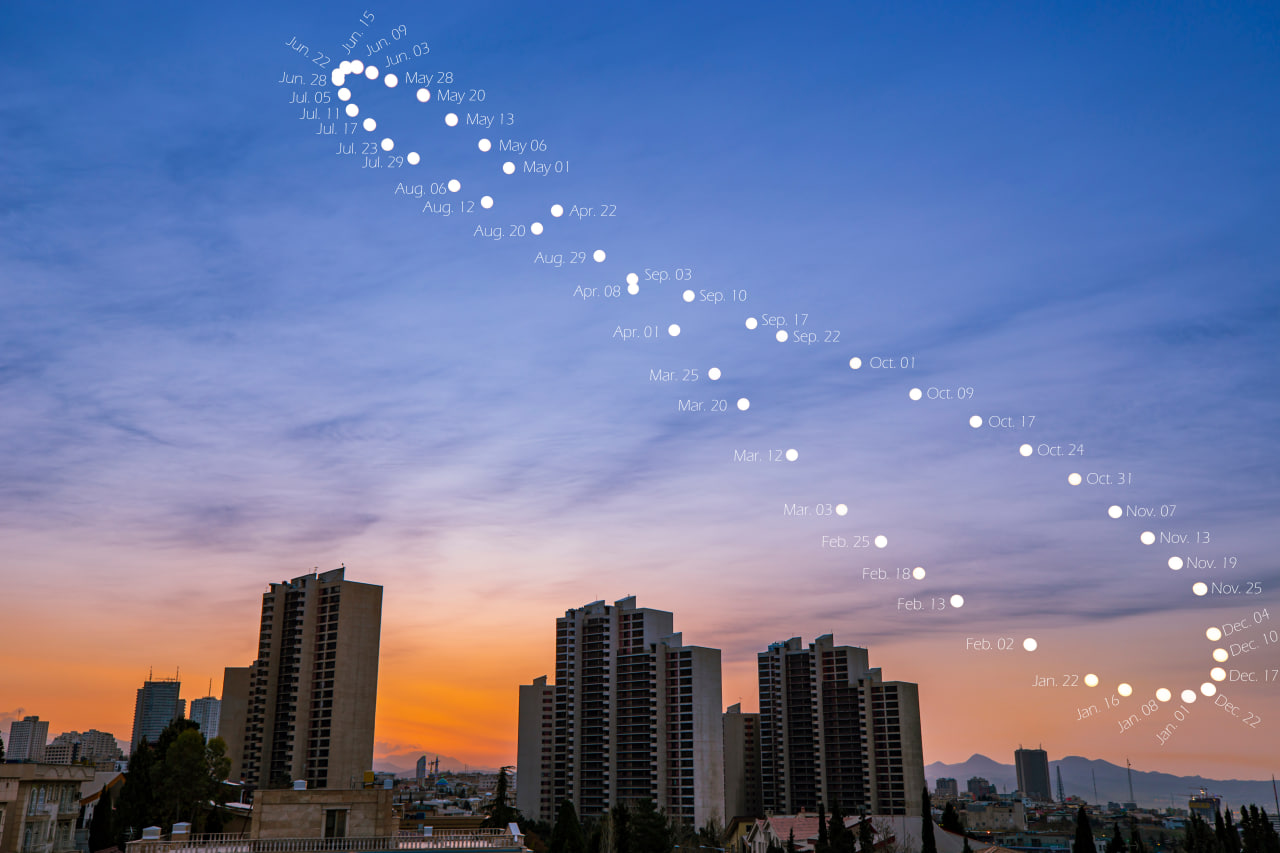
The solar analemma: annual celestial motion, clock time and the observer’s horizon in one trace.
The So-Called Astronomy Course, GA 323, and The Fourth Dimension, GA 324a, are then read slowly with the diagrams present, supported by simple work with Cassini ovals, lemniscates and plots of observed planetary motion.
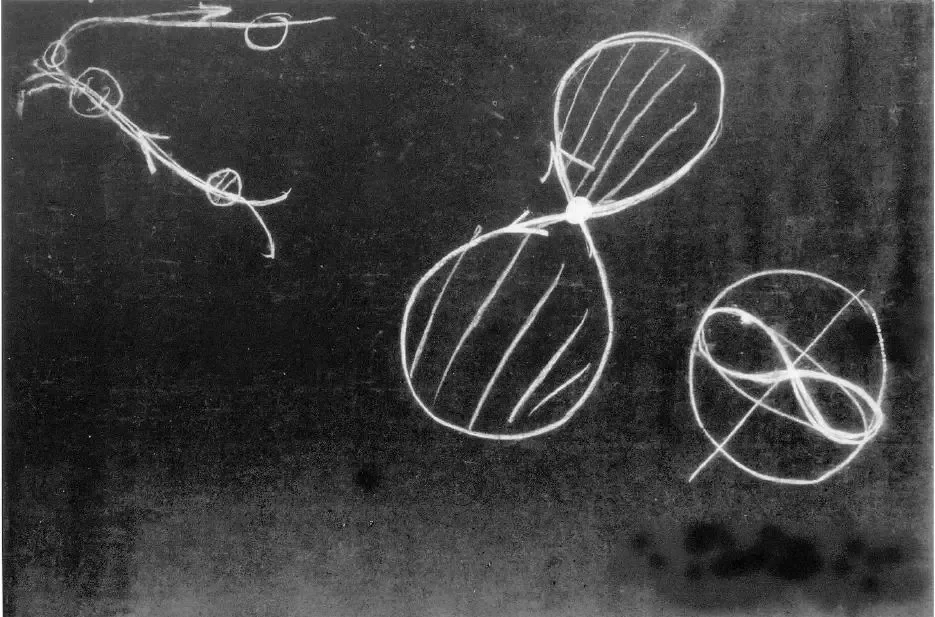
A lemniscatory planetary drawing from the astronomy course: the projected curves are studies in spatial thinking, not an orbit chart.
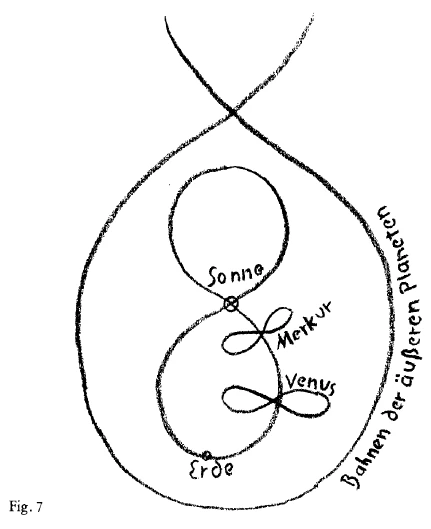
A later diagram of Earth, Sun, Mercury and Venus, useful for comparing a reconstruction with the lecture drawings.
Vreede, Sucher and Hilton follow, with a journal of direct sky observation. Schrapp belongs at the end, where the reader must distinguish original statement, later interpretation and astronomical observation.