The Lemniscatory Path System
Roland Schrapp's discovery that the Sun and Earth do not orbit each other in simple circles or ellipses — they trace a double figure-eight, a lemniscate, as they advance together toward the solar apex near Hercules. This is the geometric foundation of everything in this app.
Figure · The Shape of the Path
The Double Lemniscate of Sun & Earth
When you observe the Sun and Earth from outside the solar system — tracking their true positions in three-dimensional space rather than relative to each other — neither body moves in a circle. The Sun curves one loop of a figure-eight while the Earth curves the other. The two loops share a single crossing point, and the entire double shape is called a lemniscate (from the Latin for ribbon). The Winter Solstice marks the moment when the paths cross: Sun and Earth at their closest geometric meeting.
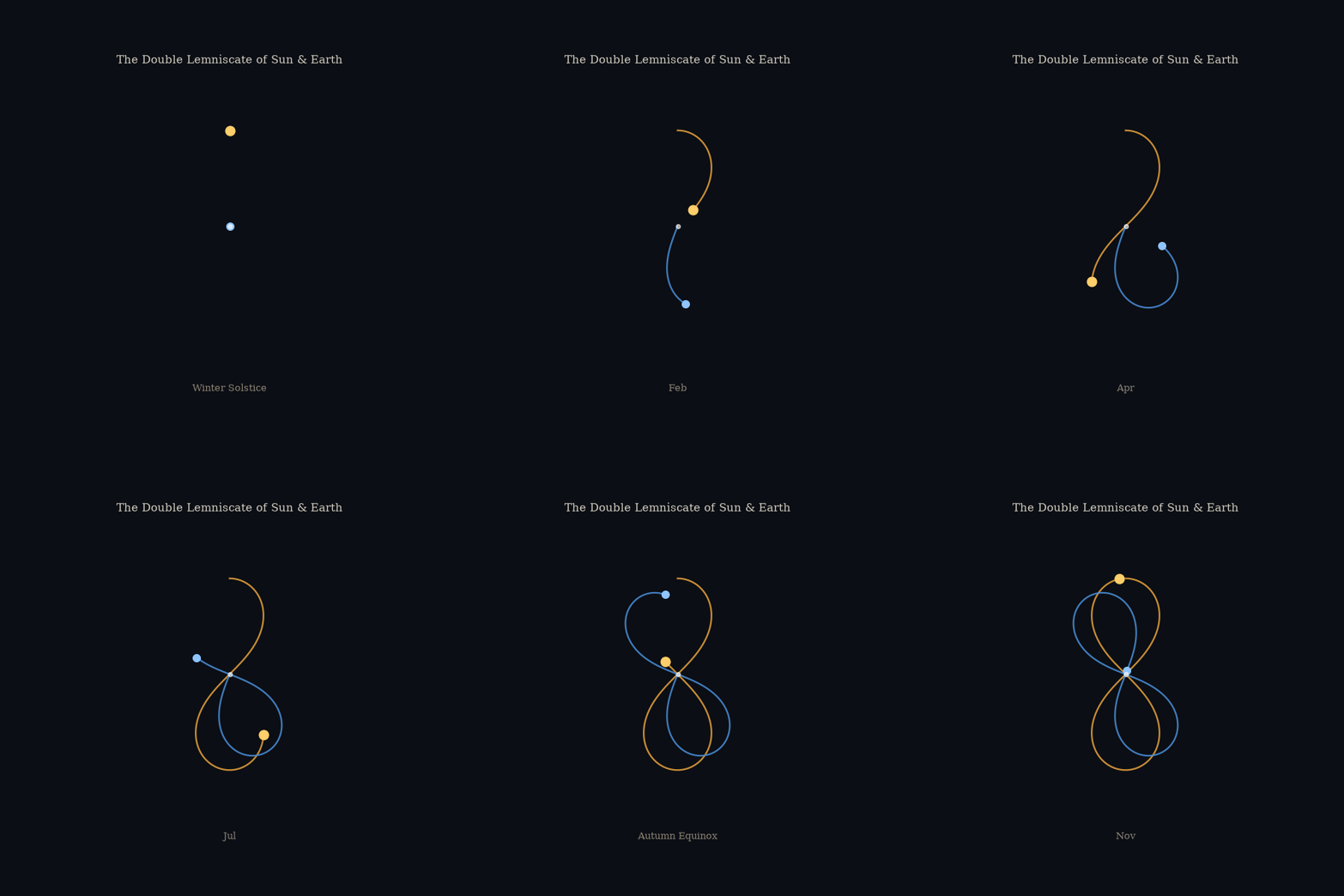
Sun · Earth · The paths cross at Winter Solstice.
Figure · Drawn from the Geometry
The Inclined Double Figure-Eight
The same figure generated directly from the lemniscate curve: Sun on one lobe, Earth on the other, the single crossing at the Winter Solstice — and the whole figure held at 23.5°, the inclination of the Earth's axis against its orbital plane. That tilt is why the crossing has a season: the figure-eight and the year are the same gesture seen from two sides. Within the Sun–Earth figure, each classical sphere traces its own nested figure-eight at its own scale.
Why it matters: Classical astronomy describes the Sun–Earth relationship as a simple ellipse (Copernicus/Kepler). Schrapp observed that this description is heliocentric — it locates the Sun at a fixed point and asks where the Earth goes relative to it. When you instead ask where both go relative to the galactic frame, you see the lemniscate.
Anthroposophy has long used the lemniscate as a symbol of rhythmic breathing between polarities — between the forces of the head and the limbs, between past karma and future impulse, between systole and diastole. Schrapp showed this is not merely a symbol: it is the literal geometry of the Sun–Earth relationship in space.
[Demo text — deeper material on the connection to the zodiac sectors, the equinox axis, and the twelve formation zones will be added here.]
Figure · Movement Through Space
The Advancing Path of Sun & Earth
The lemniscate does not stay in one place. The entire figure-eight advances through space — toward the solar apex, the direction the whole solar system is moving within the Milky Way. This apex lies near the constellation Hercules. So rather than a closed loop, the real path of Sun and Earth is a rising, helical double spiral: each year the lemniscate has moved forward, and the bodies never return to exactly the same point in space. Every moment of your life occurred at a unique position in the galaxy.
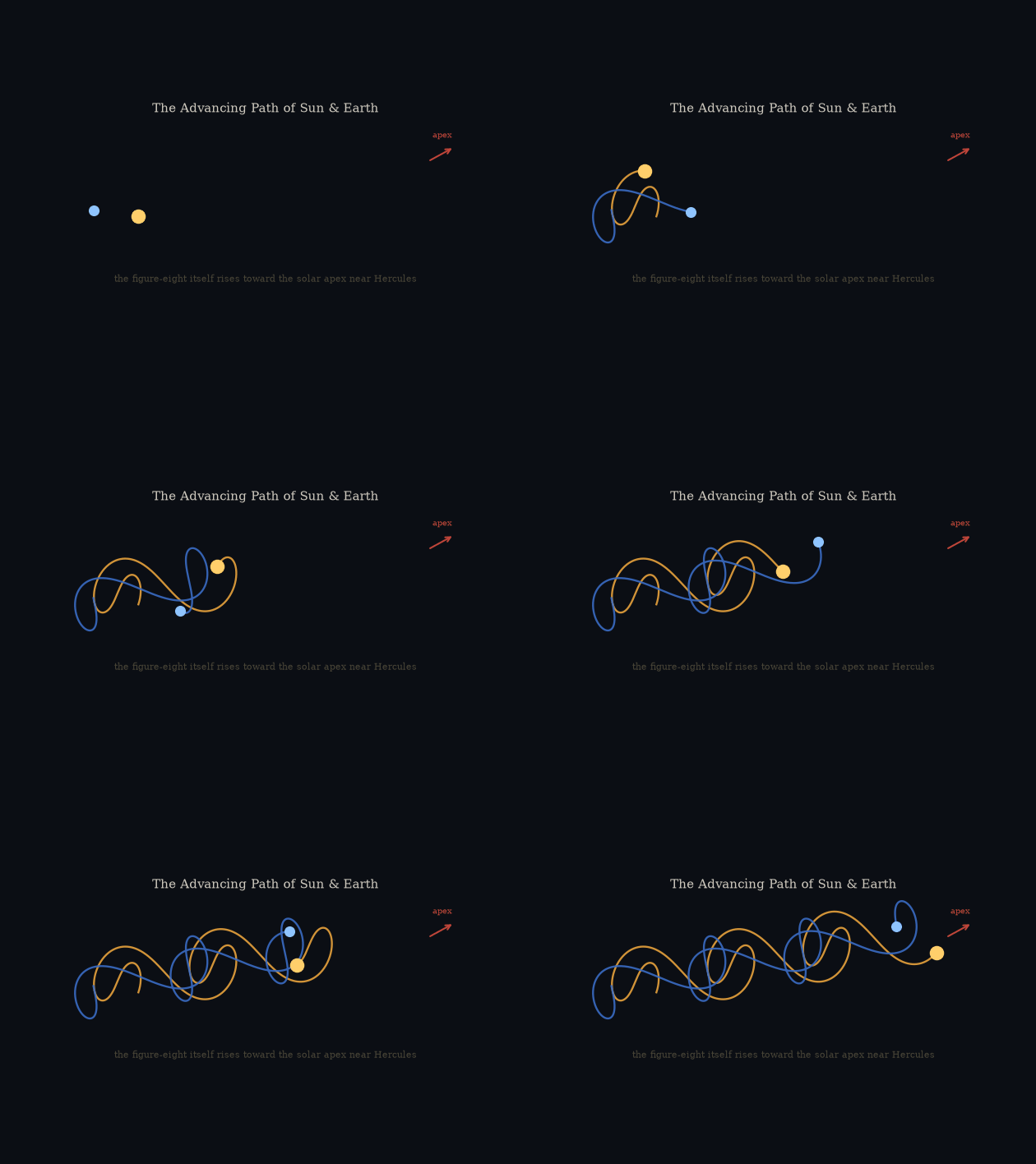
The figure-eight itself rises toward the solar apex near Hercules. The path never closes.
In This App
How the Chart Uses This
The Cosmos → Paths view renders the lemniscatory paths of all seven classical spheres — Moon, Mercury, Venus, Sun, Mars, Jupiter, Saturn — as nested figure-eights. Each sphere draws its own lemniscate at a different scale inside the Sun–Earth loop, according to Schrapp's stated rotation laws (GA period tables, pp. 116–190).
[Demo text — explanation of the pivot table, monthly rotation, axis tilt, and the relationship to the twelve crosspath formation zones (Figure 223) will be added here.]
Source & confidence: The lemniscate geometry and the Sun/Earth pivot table are stated by Schrapp in The Lemniscatory Path System (2012), Figures 74–86 (pp. 56–63). The advancing-path description follows directly from the stated geometry. The nested-lemniscate construction for the other planets uses Schrapp's per-planet rotation tables (pp. 116–190); the continuous interpolation between his discrete monthly snapshots is this app's own reconstruction and is marked “synthesis” in the chart legend. Never present the rendered paths as Schrapp's own verified positions.